• mobilitylab.org site logo
  • Mobility Lab main menu search icon:  click to do a search
    • Understanding Transportation Demand Management
    • Transportation Demand Management In Action
      • Arlington Transportation Partners
        • The Practice of Transportation Demand Management
      • Information and Outreach
        • Commuter Services
        • Messaging
        • Champions Program
      • Learn more about TDM
        • Further Reading
    • Our Research
      • Travel Behaviors
        • Transit
        • Bike
        • Walk
        • Ridesharing
        • Micromobility
      • Arlington Analysis
        • Regional Surveys
        • Evaluations
        • Building Studies
      • Market Profiles
        • All Profiles
    • Transit Oriented Communities
    • Urban Planning
    • Resources
      • The Transportation Cost-Savings Calculators
        • ROI Calculator
        • TRIMMS 4.0
      • Research Data
        • Transit APIs
        • Archived Articles
      • Video Library
      • Infographics
      • Glossary Of Key Terms
    • About Us
      • Meet Our Team
      • Careers

Urban Planning

  • Home
  • Urban planning

Transportation Tech Bubble Makes D.C. “Ripe for Disruption”

September 27, 2013

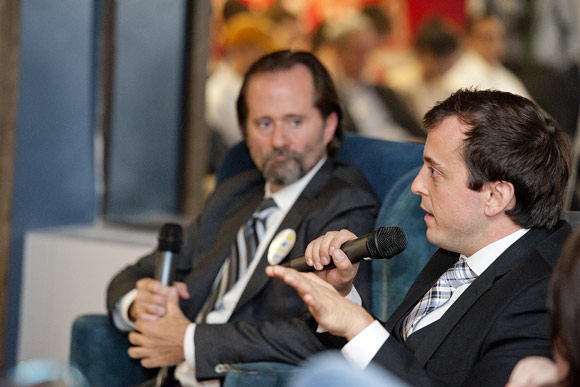
Mobility Lab’s Tom Fairchild (left) and WAMU’s Martin di Caro

The word “innovative” isn’t usually used in the same sentence as Washington D.C., but that adjective is surprisingly apt today.

The nation’s capital has flown under the radar to become one of the leaders in transportation innovation.

Recently launched services such as Uber, Hailo, Capital Bikeshare, Hitch, and RidePost are changing the way Washingtonians get around. The proliferation of these new apps and services was the topic of the evening at “Transportation in the City,” a panel discussion hosted this week at 1776 by Smart Growth America and Elevation DC.

Why D.C., and why now? These were two of the questions posed at the event, which drew a standing-room-only crowd of hipsters, geeks, and wonks in 1776’s swank industrial meeting space.

First of all, Washington D.C. is a “big but manageable” city, stated Donna Harris, co-founder of 1776. With a population of 600,000 that swells to almost twice that on any given workday, D.C. is also a city with the highest number of commuters, according to Harris.

D.C. is also a city with a transit system that is mature, but taxed to capacity. Harris said the opportunities inherent in our city made the transportation industry “ripe for disruption” by apps she refers to as “regulatory hacks.” Startups seized on opportunities present in an industry many view as too large, cumbersome, inefficient, and overregulated. And the consumer is now benefiting with more transportation choices than ever before.

A demographic shift is also under way in the nation’s capital. Ilana Preuss, vice-president and chief of staff of Smart Growth America, said that D.C. is now the biggest employer of recent college grads. These Millennials – many burdened by school debt and high rents – are making an active decision to forego the automobile as an unnecessary expense.

The decision to forego a car isn’t just a decision being made by Millennials, though. Tom Fairchild, director of Mobility Lab, pointed out that his organization is credited for removing 45,000 cars from the road each day. Martin Di Caro, transportation reporter for WAMU, repeated this idea: “Independence used to mean car keys. Now it’s a smartphone.”

While the past several years have seen enormous changes in D.C. and its suburbs, Harris said D.C.’s transportation system is “an overnight success that didn’t happen overnight.”

Fairchild echoed this sentiment by pointing to the forward-thinking work Arlington County did in the 1970s to locate its metro stations under Wilson Boulevard rather than I-66.

Di Caro, too, spoke of the importance of tying land use with transportation. With even notoriously congested Tysons Corner making the decision to ditch its parking lots, things are changing for the better.

Stewart Schwartz, director of the Coalition for Smarter Growth, points to the innovation of transportation-oriented startups as part of a larger trend in D.C. towards increased livability and revitalization that has only accelerated in recent years. The term “walkability” is thrown around so often in D.C. nowadays that it’s almost become a cliche, and the movement is spreading. Transportation apps and platforms are but one symptom of this movement.

Equity remains an issue that still needs to be addressed, however. Transportation startups are dependent in large part on the proliferation of social media, and especially smartphones. Gentrification in D.C. remains an enormous problem, Di Caro acknowledged, and this is a thorny issue a smartphone app can’t ameliorate. Fairchild intimated that the equity issue is more pernicious and pervasive, noting not only that transit benefits are typically made available only to salaried, rather than hourly workers, and also the requirement to tie bikeshare memberships to credit cards.

Harris closed the event by stating that “data is empowering.” Opening up data and making it available to all will show “dark spots on the map. Data drives transparency which drives decision making.” A positive view, to be sure. And hopefully an idea and trend that will spread throughout the region.

Photo by Barbara L. Salisbury used by permission

 
share this item

Subscribe to Receive Updates on the Latest Mobility Research and Trends

Arlington Virginia Department of Environmental Services

Transportation Resources for Arlington County (TRAC) is funded in part by grants from the U.S. Department of Transportation (DOT), the Virginia Department of Transportation (VDOT) and the Virginia Department of Rail and Public Transportation (DRPT)

TRAC Family of Sites
  • Arlington Transit
  • Arlington Transportation Partners
  • Bike Arlington
  • Capital Bikeshare
  • Car-Free Near Me
  • CommuterDirect
  • CommuterPage
  • Dieta Cero-Auto
  • The Commuter Store
  • Walk Arlington
  • Terms and Conditions
Follow Us
  • facebook
  • twitter
  • linkedin
  • youtube
  • instagram

© 2026 Mobility Lab, a program of Arlington County, Virginia

Accessibility Adjustments

Accessibility Commitment for Mobility Lab

At Mobility Lab, we are committed to making our digital presence as accessible and inclusive as reasonably possible for all users, including individuals with disabilities. Our goal is to improve the usability of https://mobilitylab.org and to support a more accessible experience for everyone, regardless of their abilities or the technologies they use.

Our Approach to Accessibility

We aim to align with the Web Content Accessibility Guidelines (WCAG), which define internationally recognized standards for digital accessibility. While full compliance cannot always be guaranteed, we strive to implement improvements where feasible and regularly review accessibility-related aspects of our website. Accessibility is an ongoing process, and we are committed to improving the experience over time as technologies, standards, and user needs evolve.

Accessibility Features

To support accessibility, https://mobilitylab.org may utilize tools/plugins as the accessibility toolbar. This interface provides users with a range of helpful features, including:
  • Adjustable text size and contrast settings
  • Highlighting of links and text for better visibility
  • Full keyboard navigation of the toolbar interface
  • Quick launch via keyboard shortcut: Alt + . (Windows) or ⌘ + . (Mac)
Please note the following:
  • The availability and effectiveness of these features depend on the website's configuration and ongoing maintenance.
  • While we strive to ensure accessibility, we cannot guarantee that every part of https://mobilitylab.org will be fully accessible at all times. Some content may be provided by third parties or affected by technical constraints beyond our immediate control.

Feedback and Contact

We welcome your feedback. If you experience any accessibility barriers or have suggestions for improvement, please contact us: Email: info@mobilitylab.org We are committed to reviewing all inquiries and aim to respond within 3–5 business days. If you require assistance accessing any part of this website, we are happy to provide support through alternative channels upon request. Last updated: February 19, 2026
How long do you want to hide the toolbar?
Hide Toolbar Duration
Select your accessibility profile
Vision Impaired Mode
Enhances website's visuals
Seizure Safe Profile
Clear flashes & reduces color
ADHD Friendly Mode
Focused browsing, distraction-free
Blindness Mode
Reduces distractions, improves focus
Epilepsy Safe Mode
Dims colors and stops blinking
Content Modules
Font Size

Default

Line Height

Default

Color Modules
Orientation Modules