• mobilitylab.org site logo
  • Mobility Lab main menu search icon:  click to do a search
    • Understanding Transportation Demand Management
    • Transportation Demand Management In Action
      • Arlington Transportation Partners
        • The Practice of Transportation Demand Management
      • Information and Outreach
        • Commuter Services
        • Messaging
        • Champions Program
      • Learn more about TDM
        • Further Reading
    • Our Research
      • Travel Behaviors
        • Transit
        • Bike
        • Walk
        • Ridesharing
        • Micromobility
      • Arlington Analysis
        • Regional Surveys
        • Evaluations
        • Building Studies
      • Market Profiles
        • All Profiles
    • Transit Oriented Communities
    • Urban Planning
    • Resources
      • The Transportation Cost-Savings Calculators
        • ROI Calculator
        • TRIMMS 4.0
      • Research Data
        • Transit APIs
        • Archived Articles
      • Video Library
      • Infographics
      • Glossary Of Key Terms
    • About Us
      • Meet Our Team
      • Careers

Research

  • Home
  • Research
  • Building studies

“Unbundling” parking costs is a top way to promote transportation options

May 31, 2018

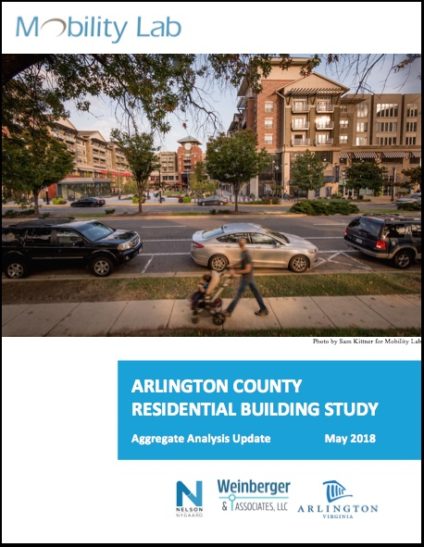
residential cover for blog postDownload

Separating the cost to rent a parking space from the cost of renting an apartment or condo may be one of the most effective ways for real-estate developers and property managers to support a more sustainable transportation sector, according to Mobility Lab’s latest study on the robust transportation demand management programs in Arlington County, Virginia.

In the county – right across the Potomac River from Washington, D.C. – parking appears to be overbuilt, with parking utilization only reaching capacity in four of the 32 buildings studied in Arlington County Residential Building Study: Aggregate Analysis Update. The average maximum use was 78 percent, meaning more than 20 percent of parking supply is excess.

The study was performed with partners Nelson\Nygaard, Weinberger & Associates, and Arlington County Commuter Services. It is part of a long-term effort by the county to make the best use of existing infrastructure, focus growth in its walkable urban villages, and understand how new development affects how the transportation network is used. The study is an aggregate analysis of transportation-performance monitoring studies conducted over the past 10 years at each of the 32 properties, and included resident surveys, parking counts, field observations, and trip generation.

Location of the buildings studied

With many of the key findings, there is a need for further research, but they also point to directions the county can go.

“Unbundling” is a critical TDM measure – perhaps the most effective. Where parking is bundled, meaning packaged in with the cost of renting, auto-ownership is higher and driving alone is 12.5 percent higher for commute trips and 40 percent higher for non-commute trips. Thus, the parking cost at work is strongly correlated with choosing to drive alone rather than taking most sustainable options, such as Metro, bus, walking, bicycling, carpooling, or teleworking.

Availability of TDM measures at study sites, as reported by the property managers

One finding from the aggregate study that begs more research is that auto users in the buildings studied are the most loyal to their mode. Fifty-two percent of respondents indicated that they always drive alone, transit users are less loyal, 39 percent always use transit, and the least loyal are ride sharers, two percent of whom always carpool or vanpool. Another two percent said they share some of the time with an average carpool/vanpool rate of 46 percent of their commute trips.

Participation in the building-level transportation studies is one of a range of TDM-related development conditions required by Arlington in certain properties throughout the county. Other TDM-related conditions (as noted in the graphic above) include bike parking, transportation information, and transit support. Additional research is needed to evaluate this finding and determine possible correlation between resident mode split and available building-level TDM programs or other factors. However, residents in the study buildings are more likely than their neighbors to commute by transit and walking. Further studies could also address the growing impact of ride-hailing services such as Uber and Lyft on both commute and non-commute trips.

Two other findings worth noting:

  • Commuters who take non-drive-alone options tend to live closer to their jobs than people who drive alone, and they are less likely to work a traditional five-days-a-week schedule.
  • While many residents are aware of TDM in principle and that there are measures or amenities available in their buildings, many residents are not well-informed on the topic. A majority, 84 percent, say they are aware of at least one service (sometimes erroneously) and 57 percent say they have tried at least one offered measure. Property managers are also not always well informed with respect to their obligations and offerings.

For more best practices along these lines, read our article 12 ways developers can guide tenants to better transportation decisions.

 
share this item

Subscribe to Receive Updates on the Latest Mobility Research and Trends

Arlington Virginia Department of Environmental Services

Transportation Resources for Arlington County (TRAC) is funded in part by grants from the U.S. Department of Transportation (DOT), the Virginia Department of Transportation (VDOT) and the Virginia Department of Rail and Public Transportation (DRPT)

TRAC Family of Sites
  • Arlington Transit
  • Arlington Transportation Partners
  • Bike Arlington
  • Capital Bikeshare
  • Car-Free Near Me
  • CommuterDirect
  • CommuterPage
  • Dieta Cero-Auto
  • The Commuter Store
  • Walk Arlington
  • Terms and Conditions
Follow Us
  • facebook
  • twitter
  • linkedin
  • youtube
  • instagram

© 2026 Mobility Lab, a program of Arlington County, Virginia

Accessibility Adjustments

Powered by OneTap

Accessibility Commitment for Mobility Lab

At Mobility Lab, we are committed to making our digital presence as accessible and inclusive as reasonably possible for all users, including individuals with disabilities. Our goal is to improve the usability of https://mobilitylab.org and to support a more accessible experience for everyone, regardless of their abilities or the technologies they use.

Our Approach to Accessibility

We aim to align with the Web Content Accessibility Guidelines (WCAG), which define internationally recognized standards for digital accessibility. While full compliance cannot always be guaranteed, we strive to implement improvements where feasible and regularly review accessibility-related aspects of our website. Accessibility is an ongoing process, and we are committed to improving the experience over time as technologies, standards, and user needs evolve.

Accessibility Features

To support accessibility, https://mobilitylab.org may utilize tools/plugins as the accessibility toolbar. This interface provides users with a range of helpful features, including:
  • Adjustable text size and contrast settings
  • Highlighting of links and text for better visibility
  • Full keyboard navigation of the toolbar interface
  • Quick launch via keyboard shortcut: Alt + . (Windows) or ⌘ + . (Mac)
Please note the following:
  • The availability and effectiveness of these features depend on the website's configuration and ongoing maintenance.
  • While we strive to ensure accessibility, we cannot guarantee that every part of https://mobilitylab.org will be fully accessible at all times. Some content may be provided by third parties or affected by technical constraints beyond our immediate control.

Feedback and Contact

We welcome your feedback. If you experience any accessibility barriers or have suggestions for improvement, please contact us: Email: info@mobilitylab.org We are committed to reviewing all inquiries and aim to respond within 3–5 business days. If you require assistance accessing any part of this website, we are happy to provide support through alternative channels upon request. Last updated: February 19, 2026
How long do you want to hide the toolbar?
Hide Toolbar Duration
Select your accessibility profile
Vision Impaired Mode
Enhances website's visuals
Seizure Safe Profile
Clear flashes & reduces color
ADHD Friendly Mode
Focused browsing, distraction-free
Blindness Mode
Reduces distractions, improves focus
Epilepsy Safe Mode
Dims colors and stops blinking
Content Modules
Font Size

Default

Line Height

Default

Color Modules
Orientation Modules