Education is key to improving public-transportation ridership in low-income communities.
When someone gives up her only parking spot in front of her home for a carshare vehicle for the whole community, you know you’re getting through to people.
That’s exactly what happened in Boulder, Colorado – and may be happening even more soon – as a unique partnership began this year between the local housing authority, a nonprofit carsharing organization, and a nonprofit bikeshare company.
A Unique Partnership
Boulder Housing Partners (BHP), in partnership with Boulder nonprofits eGo CarShare and Boulder B-cycle, have begun offering a “multi-modal toolkit” to 271 BHP rental households.
What that means is that these households have free annual B-cycle bikeshare memberships, free annual transit passes called Neighborhood Eco Passes that allow them to ride buses operated by RTD, and a 50 percent discount on carshare vehicles through eGo CarShare. Through the grant partnership, eGo CarShare was able to add carshare vehicles in or near five low-income communities served by BHP.
“Transportation, for a lot of folks, can be a #2 or #3 top cost. So how can public transportation be more accessible, and how do we encourage them to use it?” asked Tim Beal, director of sustainable communities at BHP.
Karen Worminghaus, executive director at eGo CarShare, helped lead the effort in securing a $100,000 Congestion Mitigation Air Quality (CMAQ) grant to launch the program, and additional funding came from Mile High Connects and The Denver Foundation.
Education is the Key to Success
“We have worked very hard this year to get NECO Passes out to more than 280 BHP residents. Next year, we look forward to being able to spend more time on education and outreach so that residents can maximize the synergistic benefits of transit, carshare, and bikeshare,” Worminghaus said. “Access to these resources should allow the average household to save at least $250 per month. This is a significant savings, particularly for low-income housholds.”
The partners are estimating that the program will result in 277,440 fewer single-occupant vehicle trips – and nearly 1.3 million fewer vehicle miles per year – in Denver and Boulder, with a focus on the peak ozone months of March to September.
Beal added, “There is a lot of focus by the Boulder City Council towards getting cars off the road. It is upping the plan for carbon reduction, and, as a housing authority, we are trying to parallel that. For instance, we are up to one megawatt of solar power being used on our sites.”
What Beal and his partners in the effort have realized is that receiving a grant to start a program is only the first step. Often getting short shrift is actually getting people acclimated to the program.
“There’s a lot of up-front education needed for bikeshare and carshare. We’re just starting to delve into the social-engagement part, and it’s what we need to learn more about,” he said.
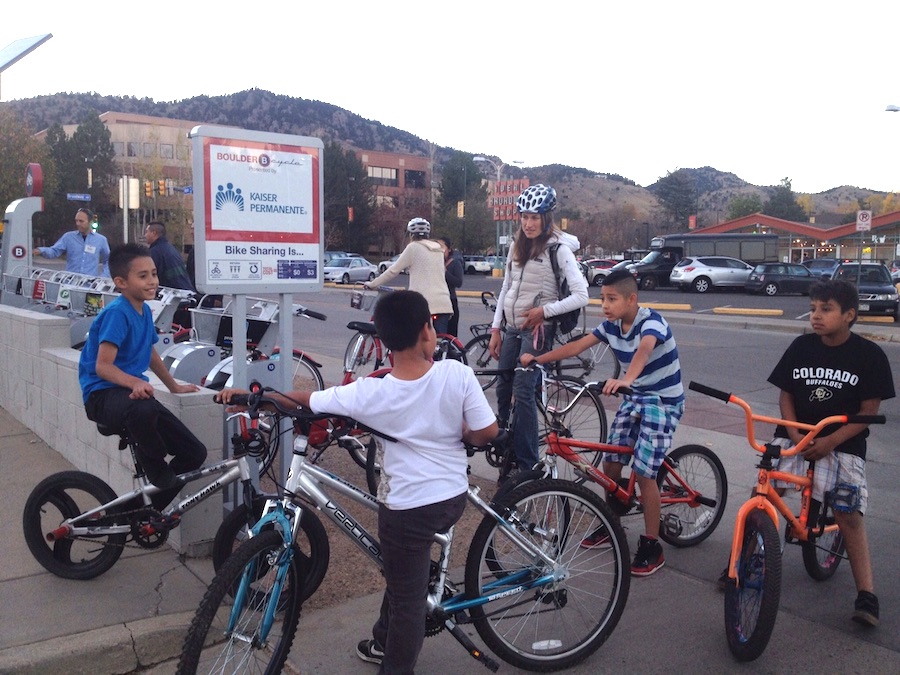
“We have been doing workshops and open houses. We did our first really big one in October and got a great turnout. Residents learned where the closest eGo CarShare vehicles were stationed and how to reserve and access the cars. We had B-cycles available and a local professional bike racer to take people on rides, learn how to put on their helmets, how to get into bike lanes, and how to get the B-cycles out of the docks. We did a workshop with a local group called Community Cycles to help people learn about bike repair. We do bike giveaways during the holidays. It all ties in with the bigger city goal of encouraging more public-transportation ridership.”
Early Success
Although it’s still too early to fully understand how well the program is working, early surveys suggest that 72 to 78 percent of the recipients are using at least one element of the transportation toolkit, Beal said.
He added, “I think the bus will definitely be the most used of the various options. Boulder has a good bus system, and most of our properties are located close to major bus routes. And we have senior sites where the program is gaining momentum. Many of those residents may not have a car because they only need to go shopping one or two times a week. So the combination of a transit pass and carsharing is the perfect fit for them.”
Giving up that personal vehicle for a community carshare is starting to not sound so inconvenient after all.
Photo courtesy of eGo CarShare.