• mobilitylab.org site logo
  • Mobility Lab main menu search icon:  click to do a search
    • Understanding Transportation Demand Management
    • Transportation Demand Management In Action
      • Arlington Transportation Partners
        • The Practice of Transportation Demand Management
      • Information and Outreach
        • Commuter Services
        • Messaging
        • Champions Program
      • Learn more about TDM
        • Further Reading
    • Our Research
      • Travel Behaviors
        • Transit
        • Bike
        • Walk
        • Ridesharing
        • Micromobility
      • Arlington Analysis
        • Regional Surveys
        • Evaluations
        • Building Studies
      • Market Profiles
        • All Profiles
    • Transit Oriented Communities
    • Urban Planning
    • Resources
      • The Transportation Cost-Savings Calculators
        • ROI Calculator
        • TRIMMS 4.0
      • Research Data
        • Transit APIs
        • Archived Articles
      • Video Library
      • Infographics
      • Glossary Of Key Terms
    • About Us
      • Meet Our Team
      • Careers

The Practice of Transportation Demand Management

  • Home
  • Transportation demand management
  • Commuter services

Buses fuel the core of Microsoft’s aggressive employee-commute program

December 11, 2017

This article is excerpted from the author’s LinkedIn page.

At Microsoft, our Connector Commuter Bus (pictured above) recently had its 10th anniversary.

And that’s just one of the things worth celebrating in the company’s commuter program.

Microsoft’s Puget Sound campus in Seattle is like a small city, with buildings, roads, infrastructure, and 44,000 people. How to responsibly get those occupants to, from, and around that small city has been a priority for Microsoft Real Estate and Facilities (RE&F) for going on three decades. During that time, Microsoft’s web of transportation services – the Commute program – has decreased total carbon emissions generated by its commuting employees by 69.3 million pounds.

Good for traffic congestion, good for reducing employee stress – and great for the environment.

In the U.S., driving alone to work is declining. Still, by the last available census data, only 24 percent of the U.S. workforce chose carpooling or mass-transit options. At Microsoft, 43 percent of workers do: 19,000 employees using alternatives to driving alone on any given day.

These alternative options cover a wide array of choices. Microsoft’s Seattle employees are given subsidized transit passes, providing unlimited rides on buses, trains, and water taxis. They also get a Guaranteed Ride Home. Carpoolers and vanpoolers enjoy preferential parking, and ride-matching and other support. Microsoft garages hold electric car-charging stations. More than 200 shuttle vehicles (including hybrid and electric) transport employees around campus or off-campus to transit hubs. Zipcar, a carsharing option on campus, allows employees daytime access to a car, for errands or meetings, at a discount.

To help employees make the most of these benefits, RE&F created a pilot program, “MERGE“ (an acronym for Manage, Explore, Reserve, Go Everywhere), a mobile-friendly tool which puts all Microsoft Commute Services together in one place, allowing employees to plan trips and to book shuttles and Connectors. There are even programs to help compensate bicycle commuters for the costs of purchasing and maintaining their bikes.

While lots of companies offer commuting support, it’s Microsoft’s deep bench of choices that makes it noteworthy.
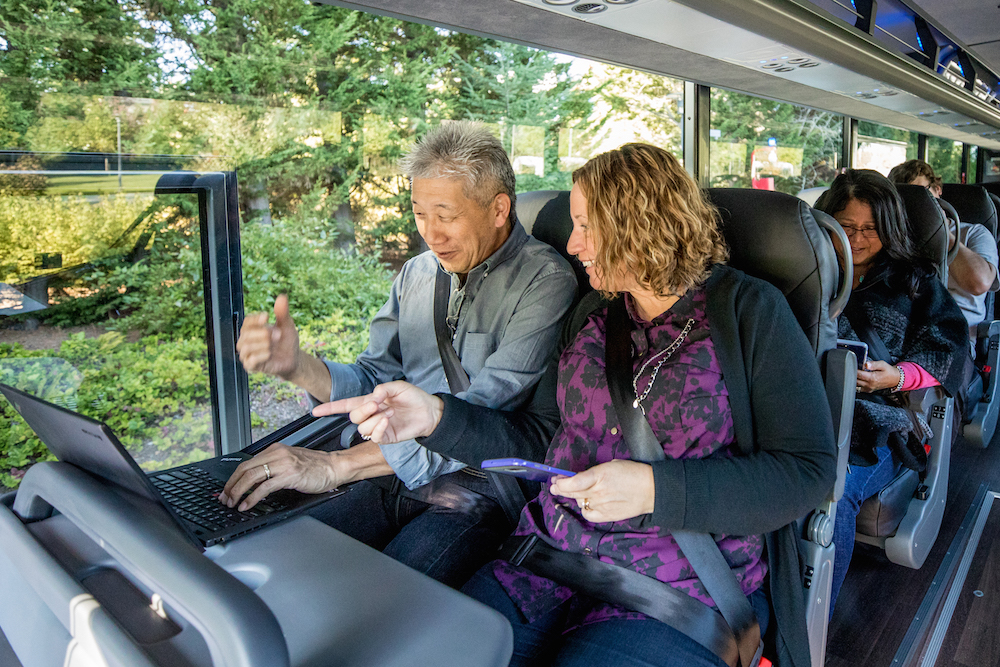
The crown jewel is Microsoft Connector, the private bus service that began 10 years ago with five routes and has grown to 23. And continues to grow. Today, a network of 94 Connector stops transport an average of 4,300 employees to and from work each day – up from 3,600 a year ago.

Microsoft Connector is meeting a need. Many Connector commuters use the time to check email and take care of other work tasks, thanks to the WiFi connectivity and AC power at the seats.

But there’s a bigger advantage still. Taken together, the services offered by Microsoft’s Commute program eliminated 7.63 million single-occupancy car trips to and from the Puget Sound campus in 2016.

Saving time and saving energy – not a bad achievement for Microsoft’s commuters.

 
share this item

Subscribe to Receive Updates on the Latest Mobility Research and Trends

Arlington Virginia Department of Environmental Services

Transportation Resources for Arlington County (TRAC) is funded in part by grants from the U.S. Department of Transportation (DOT), the Virginia Department of Transportation (VDOT) and the Virginia Department of Rail and Public Transportation (DRPT)

TRAC Family of Sites
  • Arlington Transit
  • Arlington Transportation Partners
  • Bike Arlington
  • Capital Bikeshare
  • Car-Free Near Me
  • CommuterDirect
  • CommuterPage
  • Dieta Cero-Auto
  • The Commuter Store
  • Walk Arlington
  • Terms and Conditions
Follow Us
  • facebook
  • twitter
  • linkedin
  • youtube
  • instagram

© 2026 Mobility Lab, a program of Arlington County, Virginia

Accessibility Adjustments

Powered by OneTap

Accessibility Commitment for Mobility Lab

At Mobility Lab, we are committed to making our digital presence as accessible and inclusive as reasonably possible for all users, including individuals with disabilities. Our goal is to improve the usability of https://mobilitylab.org and to support a more accessible experience for everyone, regardless of their abilities or the technologies they use.

Our Approach to Accessibility

We aim to align with the Web Content Accessibility Guidelines (WCAG), which define internationally recognized standards for digital accessibility. While full compliance cannot always be guaranteed, we strive to implement improvements where feasible and regularly review accessibility-related aspects of our website. Accessibility is an ongoing process, and we are committed to improving the experience over time as technologies, standards, and user needs evolve.

Accessibility Features

To support accessibility, https://mobilitylab.org may utilize tools/plugins as the accessibility toolbar. This interface provides users with a range of helpful features, including:
  • Adjustable text size and contrast settings
  • Highlighting of links and text for better visibility
  • Full keyboard navigation of the toolbar interface
  • Quick launch via keyboard shortcut: Alt + . (Windows) or ⌘ + . (Mac)
Please note the following:
  • The availability and effectiveness of these features depend on the website's configuration and ongoing maintenance.
  • While we strive to ensure accessibility, we cannot guarantee that every part of https://mobilitylab.org will be fully accessible at all times. Some content may be provided by third parties or affected by technical constraints beyond our immediate control.

Feedback and Contact

We welcome your feedback. If you experience any accessibility barriers or have suggestions for improvement, please contact us: Email: info@mobilitylab.org We are committed to reviewing all inquiries and aim to respond within 3–5 business days. If you require assistance accessing any part of this website, we are happy to provide support through alternative channels upon request. Last updated: February 19, 2026
How long do you want to hide the toolbar?
Hide Toolbar Duration
Select your accessibility profile
Vision Impaired Mode
Enhances website's visuals
Seizure Safe Profile
Clear flashes & reduces color
ADHD Friendly Mode
Focused browsing, distraction-free
Blindness Mode
Reduces distractions, improves focus
Epilepsy Safe Mode
Dims colors and stops blinking
Content Modules
Font Size

Default

Line Height

Default

Color Modules
Orientation Modules