• mobilitylab.org site logo
  • Mobility Lab main menu search icon:  click to do a search
    • Understanding Transportation Demand Management
    • Transportation Demand Management In Action
      • Arlington Transportation Partners
        • The Practice of Transportation Demand Management
      • Information and Outreach
        • Commuter Services
        • Messaging
        • Champions Program
      • Learn more about TDM
        • Further Reading
    • Our Research
      • Travel Behaviors
        • Transit
        • Bike
        • Walk
        • Ridesharing
        • Micromobility
      • Arlington Analysis
        • Regional Surveys
        • Evaluations
        • Building Studies
      • Market Profiles
        • All Profiles
    • Transit Oriented Communities
    • Urban Planning
    • Resources
      • The Transportation Cost-Savings Calculators
        • ROI Calculator
        • TRIMMS 4.0
      • Research Data
        • Transit APIs
        • Archived Articles
      • Video Library
      • Infographics
      • Glossary Of Key Terms
    • About Us
      • Meet Our Team
      • Careers

The Practice of Transportation Demand Management

  • Home
  • Transportation demand management
  • Messaging

Rebranding “TDM” Could Fix the Industry’s Communications Struggle

August 11, 2015

CMAQ unfair

TDM practitioners should start exploring beyond the limits of the industry’s largest federal funding mechanism.

Would a common definition of the term and practice of transportation demand management help the industry find other funding sources, do better lobbying for policies, and gain wider acceptance and popularity?

And, as we at Mobility Lab constantly ponder internally, is the user-unfriendly term TDM keeping us from reaching these goals as well?

Kirk Hovenkotter, a program analyst at TransitCenter and a Mobility Lab contributor, asked these questions and urged TDM professionals to potentially reexamine their organizational goals and definitions of their work during a recent talk in Baltimore at the Association for Commuter Transportation annual international conference.

(Flip through his presentation here.)

With 59 percent of funding for regional TDM programs throughout the country coming from the federal Congestion Mitigation and Air Quality (CMAQ) Program, Hovenkotter said TDM organizations are somewhat forced to tailor their work to goals that are not Americans’ top priorities.
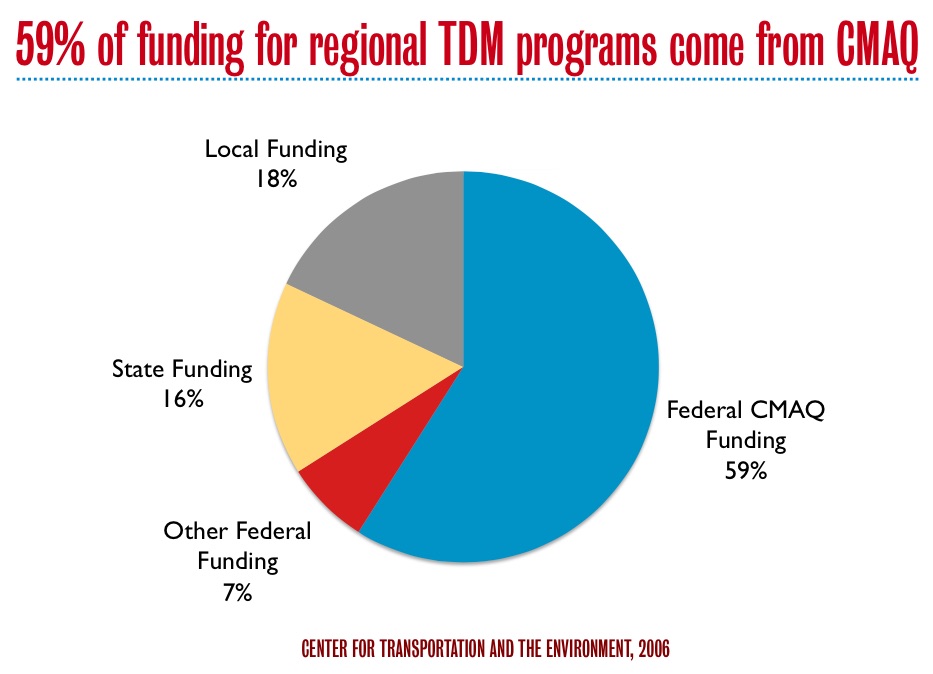
CMAQ funding

Some of TransitCenter’s latest research shows that people 30-years-old and above choose their mode of travel based on factors that don’t align with CMAQ’s requirements to target congestion mitigation and air pollution.

Total travel time, travel time reliability, and having a mode that allows them to be flexible in the times they travel are the top three ways people choose their mode of travel.

“The top motivations for people weren’t traffic congestion or environmental impact, but access to affordable, reliable, efficient transportation options,” Hovenkotter said.

He also noted: the Federal Highway Administration (FHWA) found that businesses that implement TDM programs do so because they were either responding to regulation or trying to recruit top talent. Congestion mitigation and air quality were not top priorities.

Kirk Hovenkotter Kirk Hovenkotter

Hovenkotter, in stressing the limitations of the TDM phrase, noted that it is defined differently from organization to organization.

Having examined how TDM practitioners across the U.S. define their core work, TransitCenter has detected a transition from calling it “TDM” to repositioning it as simply “transportation options.”

He said the “bellwether” case may be the Oregon Department of Transportation’s statewide plan that forgoes the phrase “TDM” for “transportation options” and is funded by a grant from the FHWA.

The Oregon DOT plan “shies away from TDM and recognizes that the benefits of ‘transportation options’ go beyond congestion mitigation and air quality, and that many of the users who will be implementing strategies don’t have that primary focus. Their definition of ‘transportation options’ says nothing about congestion mitigation, system efficiency, and increasing occupancy. It focuses on creating choice, which is just a stark contrast . It really broadens its perspective.

“Please take the time to read the Oregon Transportation Options Plan. It is 80 pages long, but I was on the edge of my seat the entire time,” he added, to laughs.

Suggesting that ACT could potentially take on the cause of rebranding the industry to carry forward the Oregon DOT’s efforts, Hovenkotter said, “There is this fine line we have to walk between being too broad and too vague and losing people that way.

“But I think the idea of ‘transportation options’ is so much more clear to me than ‘managing demand.’ It’s something you can communicate so much more easily to electeds or someone you see on the street.”

 
share this item

Subscribe to Receive Updates on the Latest Mobility Research and Trends

Arlington Virginia Department of Environmental Services

Transportation Resources for Arlington County (TRAC) is funded in part by grants from the U.S. Department of Transportation (DOT), the Virginia Department of Transportation (VDOT) and the Virginia Department of Rail and Public Transportation (DRPT)

TRAC Family of Sites
  • Arlington Transit
  • Arlington Transportation Partners
  • Bike Arlington
  • Capital Bikeshare
  • Car-Free Near Me
  • CommuterDirect
  • CommuterPage
  • Dieta Cero-Auto
  • The Commuter Store
  • Walk Arlington
  • Terms and Conditions
Follow Us
  • facebook
  • twitter
  • linkedin
  • youtube
  • instagram

© 2026 Mobility Lab, a program of Arlington County, Virginia

Accessibility Adjustments

Powered by OneTap

Accessibility Commitment for Mobility Lab

At Mobility Lab, we are committed to making our digital presence as accessible and inclusive as reasonably possible for all users, including individuals with disabilities. Our goal is to improve the usability of https://mobilitylab.org and to support a more accessible experience for everyone, regardless of their abilities or the technologies they use.

Our Approach to Accessibility

We aim to align with the Web Content Accessibility Guidelines (WCAG), which define internationally recognized standards for digital accessibility. While full compliance cannot always be guaranteed, we strive to implement improvements where feasible and regularly review accessibility-related aspects of our website. Accessibility is an ongoing process, and we are committed to improving the experience over time as technologies, standards, and user needs evolve.

Accessibility Features

To support accessibility, https://mobilitylab.org may utilize tools/plugins as the accessibility toolbar. This interface provides users with a range of helpful features, including:
  • Adjustable text size and contrast settings
  • Highlighting of links and text for better visibility
  • Full keyboard navigation of the toolbar interface
  • Quick launch via keyboard shortcut: Alt + . (Windows) or ⌘ + . (Mac)
Please note the following:
  • The availability and effectiveness of these features depend on the website's configuration and ongoing maintenance.
  • While we strive to ensure accessibility, we cannot guarantee that every part of https://mobilitylab.org will be fully accessible at all times. Some content may be provided by third parties or affected by technical constraints beyond our immediate control.

Feedback and Contact

We welcome your feedback. If you experience any accessibility barriers or have suggestions for improvement, please contact us: Email: info@mobilitylab.org We are committed to reviewing all inquiries and aim to respond within 3–5 business days. If you require assistance accessing any part of this website, we are happy to provide support through alternative channels upon request. Last updated: February 19, 2026
How long do you want to hide the toolbar?
Hide Toolbar Duration
Select your accessibility profile
Vision Impaired Mode
Enhances website's visuals
Seizure Safe Profile
Clear flashes & reduces color
ADHD Friendly Mode
Focused browsing, distraction-free
Blindness Mode
Reduces distractions, improves focus
Epilepsy Safe Mode
Dims colors and stops blinking
Content Modules
Font Size

Default

Line Height

Default

Color Modules
Orientation Modules